

Human Resource Management (Labour Standards)
Amid the challenges and rapid changes in the energy industry in 2025, TPI Polene Power Public Company Limited remains committed to sustainable development as the core principle of its business operations. The Company places strong emphasis on strategic human resource management, covering workforce planning, recruitment, and the retention of high-potential personnel in order to create a competitive advantage and support the long-term transition of the manufacturing and energy sectors.
The Company believes that people are a key driver of operational efficiency and workplace safety. Therefore, it continuously focuses on developing the skills and readiness of employees at all levels by creating a work environment that supports learning and employee engagement, encouraging collaboration within the organization and promoting workplace innovation. These efforts contribute to strengthening the Company’s business growth in a stable and sustainable manner.
In addition, the Company implements employee care policies based on the principles of human rights, fairness, and equality, respecting the dignity of every employee and ensuring a workplace free from discrimination. The Company also promotes equal opportunities for career advancement. This approach not only strengthens the Company’s human resource management system but also reflects its commitment to enhancing employee well-being while fulfilling its responsibilities toward society and all stakeholders in a sustainable manner.
- Sustainable Employment Management
The Company drives the organization through a strategic human capital management approach to accommodate economic and technological changes. Workforce planning and personnel structure are reviewed annually to ensure appropriate staffing and improve operational efficiency, while also promoting employee well-being through the management of safe working hours in accordance with work–life balance principles. The Company also focuses on attracting and retaining high-potential personnel over the long term through a compensation and benefits system that creates positive motivation. In addition, internationally standardized psychological assessment tools are applied in the recruitment process to ensure transparency, eliminate bias, and maintain alignment with the organizational culture in a systematic manner.
Regarding its recruitment strategy, the Company places importance on building a diverse and inclusive organization by providing equal career opportunities for all target groups, including persons with disabilities, the elderly, and disadvantaged groups, in order to leverage diverse capabilities for organizational development. At the same time, the Company aims to create a positive impact on the grassroots economy by promoting local employment opportunities, generating income and stimulating economic growth in communities surrounding its operations. In addition, the Company enhances workplace safety standards and ensures the protection of employees’ personal data in compliance with international laws and regulations, thereby building confidence and stability for personnel at all levels.
Management Guidelines
Compliance with Code of Conduct and Labor Standards: The Company prioritizes adherence to the Code of Conduct and labor laws at both national and international levels. It upholds international human rights principles, including the United Nations Universal Declaration of Human Rights and the International Labor Organization (ILO) Declaration on Fundamental Rights at Work, as well as Thai labor laws, such as the Labor Protection Act, B.E. 2560 (2017). The Company conducts annual workforce planning to ensure an appropriate number of employees to support its operations, thereby reducing the risk of excessive working hours. The Company is committed to providing attractive compensation, offering remuneration above the market average, while placing strong emphasis on equitable pay practices. Committed to responsible operations, the Company ensures fair treatment of all workers within its organization and supply chain. By complying with these standards, the Company promotes organizational sustainability and strengthens international trust. Key commitments include :
- The Company strictly enforces a Zero Tolerance policy against child labor across all operations and throughout its supply chain, as stipulated in the Code of Conduct and the Supplier Code of Conduct for Procurement and Contracting. The Company implements rigorous identity verification and age screening measures in accordance with international standards. In addition, the Company extends its commitment to child rights protection by supporting 15 educational scholarships, ranging from kindergarten to undergraduate level, and by collaborating with school networks and community recreational activities to develop youth skills. These initiatives aim to enhance quality of life and establish a sustainable educational foundation.
- The Company does not support or engage in any form of forced labor. Clear policies are communicated through the Code of Conduct and the Supplier Code of Conduct for Procurement and Contracting, and training programs are conducted to enhance knowledge and awareness among employees, suppliers, and contractors. These measures ensure that operations comply with laws and corporate ethics. The Company also implements practical preventive measures against forced labor throughout the employment cycle, confirming voluntary employment and extending screening processes to cover suppliers and contractors.
- The Company is committed to managing equality and equal opportunity through a non-discrimination policy that applies across all organizational operations, with continuous and transparent public disclosure. The policy imposes no limitations based on race, religion, gender, age, sexual orientation, disability, nationality, or Indigenous Rights. The Company maintains an open and inclusive recruitment and selection process for candidates from all target groups, without restrictions related to personal beliefs or physical characteristics. It also promotes employment opportunities for individuals of all age groups, including the elderly, in accordance with job suitability, while providing tangible career opportunities for persons with disabilities and disadvantaged groups. These practices reaffirm the Company’s commitment to maintaining a workplace environment that respects human value and equality in all aspects, in alignment with international standards.
- The Company does not use gender identity and sexual orientation as barriers to employment opportunities. Job announcements do not impose gender restrictions, and gender or sexual orientation is not used as a criterion for promotion. Instead, knowledge, competence, and job performance are used as the primary evaluation criteria.In addition, the Company’s work regulations strictly prohibit sexual harassment, including any acts of indecent or inappropriate behavior toward employees.
- The Company prioritizes labor risk management at every stage by assessing labor risks, including child labor, forced labor, and discrimination. This assessment extends to external labor partners and contractors within the supply chain.
- Targeted and Efficient Recruitment: The Company adopts a proactive recruitment approach by leveraging online technology to reach target candidates, aligning with the new normal. Recruitment channels have been expanded, processes streamlined for faster hiring, and applications are now stored in a digital system for improved efficiency. Additionally, the Company engages with young students through various initiatives, including a job placement program for recent graduates. This program includes final orientation sessions to prepare them for the workforce, along with guidance on work-related knowledge and experience. For critical positions, candidates undergo a comprehensive selection process, including a potential assessment (Psychometric Test) and an interview conducted by a committee to ensure the selection of individuals with the appropriate knowledge, experience, and capabilities.
- The Company has a policy to support equitable compensation and ensure compliance with laws. Employees are offered attractive remuneration packages and salary adjustments that exceed the average level in the labor market, with wages sufficient to support a decent standard of living. This approach is intended to attract high-quality personnel and enhance work performance. In addition, the Company provides additional welfare benefits, such as accommodation and travel allowances for employees who are required to work in other provinces. These benefits serve as further incentives that help the organization attract and retain capable employees, while also improving workforce effectiveness in the long term.
- The Company establishes a systematic workforce planning framework and conducts annual reviews to ensure that the number of personnel is appropriate and sufficient for the workload across all operational stages. This approach serves as a key mechanism for managing working hours at an appropriate level, thereby reducing the risk of unnecessary excessive overtime.
- The Company conducts annual wage surveys of competitor businesses and other organizations located in nearby areas to compare compensation levels and determine appropriate employment and salary adjustment policies. Salary adjustments are provided annually for all employees based on their performance. In cases where the government announces an increase in the minimum wage in the area, the Company adjusts wages accordingly to maintain an appropriate standard of living for employees according to their job levels, even though the wages for certain positions may already be higher than the government-announced minimum wage. In addition, when employees resign, the Company conducts exit interviews to gather feedback on various aspects, including income and welfare benefits, which are then used to review and improve the Company’s compensation and benefits policies.
- The Company conducts clear and fair performance evaluations based on each employee's position, considering factors such as work achievements, initiative, leadership, planning, problem-solving skills, and attendance. Evaluations are carried out every four months, in April, August, and December. The average evaluation results for the year are used to determine salary adjustments, annual compensation, and promotion considerations, based on employees' abilities and performance.
Employment Performance Results in 2025
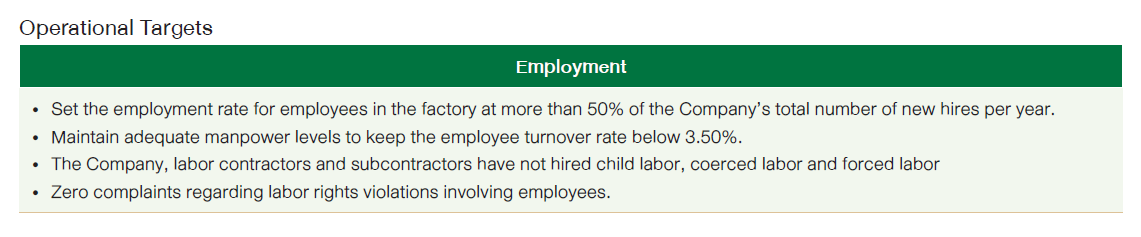
- The Company supports the local economy through employment in communities where its factories are located. A total of 1,078 permanent employees are employed at Saraburi plant and Songkhla Provincial Administrative Organization Municipal Waste Power Plant, representing 91.74% of the total workforce of 1,175 employees. In 2025, the Company also recruited 74 new employees from local communities, accounting for 70.47% of the total 105 new hires. This reflects the Company’s commitment to strengthening economic stability and promoting sustainable local employment.
- Employee turnover rate was equal to 2.13%, which indicates the efficient retention of the Company's personnel.
- 60 Employees who voluntarily resigned, accounting for 5.11% of a total of 1,175 employees.
- The Company promotes equal employment opportunities without discrimination, covering general employees, the elderly, disadvantaged groups, and persons with disabilities, in order to enhance quality of life and reduce social inequality. The key highlights in 2025 are summarized as follows :
- Creation of Employment Opportunities
The Company hired a total of 105 new employees (98 general employees and 7 elderly employees). In addition, the Company provided employment opportunities to 198 disadvantaged individuals who face limitations related to economic status and educational/ professional qualifications.
- Promotion of Quality of Life for Persons with Disabilities: In accordance with the Empowerment of Persons with Disabilities Act B.E. 2550 (2007), the Company employed a total of 12 persons with disabilities, representing 1.02% of the total workforce of 1,175 employees, as follows :
1) Direct employment (Section 33) : The Company directly employed 2 persons with disabilities to work within the organization.
2) Contribution to the Empowerment of Persons with Disabilities Fund (Section 34): The Company contributed to the fund to support the employment of 2 persons with disabilities.
3) Area-based livelihood promotion (Section 35) : The Company provided financial support of more than Baht 984,000 (Baht 123,005 per person) to 8 persons with disabilities residing in Songkhla Province (the location of the Company’s Songkhla Provincial Administrative Organization municipal waste power plant) and nearby provinces. This support aims to create sustainable careers through agricultural projects such as cattle farming, integrated farming, and oil palm cultivation.
- The Company prioritizes the employment of individuals with disabilities by offering wage rates based on educational qualifications, similar to those for general employees. The Company adheres to the principle of “Equal Pay for Equal Work. Additionally, the Company supports adjustments to the work environment to promote equality and reduce discrimination within the organization.
- The Company places importance on the principle of “Equal Pay for Equal Work.” It strictly complies with Thai labor laws and establishes its compensation structure based on job position, responsibilities, and employee competencies. For the employment of persons with disabilities, the Company applies the same wage rates based on educational qualifications as those applied to general employees. In addition, the Company provides basic skills training programs and on-the-job training, with supervisors assigned to guide and support the development of persons with disabilities and disadvantaged groups on an individual basis.
- The Company implements initiatives to promote knowledge and skills among young people nearing the completion of their bachelor's degree. These initiatives include attending final orientation events at various universities, which help prepare students for the future and provide valuable experiences, increasing their chances of successfully entering the labor market.
- 8. To enhance employee data system development, a new software system has been developed to support the efficient collection and management of employee data. The Company verifies applicants’ age information in accordance with the chain of command within Human Resources Department, as specified in the Standard Operating Procedures (SOP) and the Human Resources Work Instructions (WI).
- No child labor, no forced labor, and no compulsory labor are used. Supplier Code of Conduct is required for all business partners to sign with 99.11% of all suppliers (565 suppliers) having signed the agreement.
10.The Company collects data on various issues related to the employment process, including offer rejection rates, employee turnover rates, and the reasons for offer rejection and resignation. The Company also gathers information on job applicants’ expectations to improve the recruitment process, reduce offer rejection rates, enhance hiring quality, increase the Offer Acceptance Rate, and improve the Candidate Experience Score.
11.The Company plans to improve its recruitment management system based on the risk analysis report related to the loss of talented personnel (Talent Loss Risk) arising from the recruitment process, particularly cases where applicants withdraw before employment. This situation may occur when candidates’ salary expectations exceed their experience, making it difficult for the Company to attract highly qualified personnel. To address this issue, the Company has expanded communication channels with job applicants and collects data on candidates who decline offers. This information is used to improve recruitment development plans and ensure that the recruitment process is aligned with the changing labor market conditions.
- The Company conducts an annual labor risk assessment carried out by the Human Rights Working Committee, with Human Resources Department serving as the primary responsible unit (as part of its job description). This process ensures concrete and continuous monitoring. The risk assessment analyzes activities in which the Company interacts with employees, suppliers, customers, and local communities throughout the value chain. The details are summarized as follows :
- Scope of Labor Risk Assessment
- Potential New Operations : The Company has conducted labor due diligence and risk assessments for projects under development, namely the Songkhla Provincial Administrative Organization Municipal Waste Power Plant Project, in order to identify constraints and prepare preventive measures prior to the commencement of operations.
- Existing Operations : The assessment covers the Company’s main operational areas, including the Bangkok Head Office and the Saraburi Power Plant.
- Results of Labor Risk Assessment and Impact Mitigation
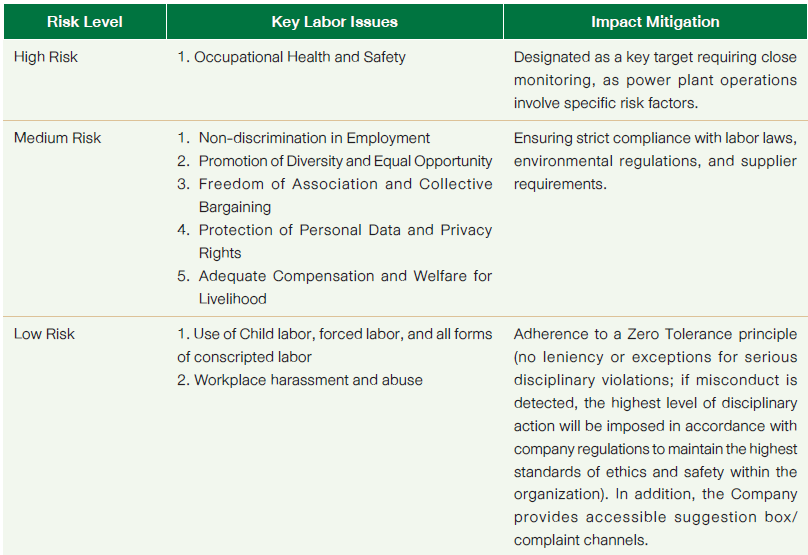
13. Summary of Employment Management Performance in 2025 is as follows :
- Prevention of Illegal Labor Practices
- Child labor : 0 cases
- Forced labo r : 0 cases
- Conscripted labor : 0 cases
- Ethics and Fair Treatment
- Employment discrimination : 0 cases
- Workplace harassment or abuse : 0 cases
- Protection of Rights and Privacy
- Complaints regarding violations of employees’ rights and privacy : 0 cases
- Fair Employment Practices
- Unfair dismissal : 0 cases
- Labor Management Relations (GRI3-3)
The Company has policies and practices to ensure fair and equitable treatment of employees in all aspects, including compensation, welfare, development, and career advancement opportunities. Additional benefits are provided in accordance with the nature of job responsibilities, such as accommodation and travel allowances for employees assigned to work outside their primary locations, serving as incentives to attract and retain capable personnel within the organization.
The Company places strong emphasis on employee capability development alongside the management of occupational health and safety, while also promoting employees’ quality of life and well-being at work. In terms of physical and mental health care, the Company implements measures to support stress management and promote positive mental well-being in the workplace. Furthermore, the Company encourages employees to play an active role in participating and proposing ideas related to the organization’s sustainability initiatives. It also provides complaint and whistleblowing mechanisms, enabling employees and stakeholders to participate in the good corporate governance process, thereby allowing the Company to monitor, investigate, and address potential issues appropriately and in a timely manner.

Management Guidelines
Within the context of continuously evolving business operations, the Company recognizes the importance of labor and labor relations as key factors influencing operational stability, organizational efficiency, and sustainable growth. The Company therefore establishes a systematic labor and labor relations management approach, based on the principles of fairness, respect for labor rights, promotion of diversity and equality, participation, and transparent communication. This approach aims to build mutual understanding between management and employees, reduce conflicts, and strengthen cooperation in driving the organization toward achieving its business objectives alongside social responsibility. The Company’s management approach includes the following :
- The Company regularly conducts employee satisfaction and engagement surveys. The results of these assessments are used as input for developing projects, policies, and operational guidelines to improve employee care in areas that align with employees’ needs, while continuously enhancing employee satisfaction and organizational engagement.
- The Company places importance on building mutual understanding between management and employees by promoting internal engagement within the organization. A Welfare Committee has been established, consisting of representatives from both the employer and employee sides, with employee representatives elected by staff. Committee members serve a two-year term, and meetings are held every three months to address issues related to the employment conditions of all employee groups. In addition, the Company holds monthly meetings of the Safety and Occupational Health Committee (Safety Committee) to continuously enhance workplace safety standards and employee well-being.
- The Company manages, addresses, and promotes diversity and equality, such as providing a prayer room for Muslim employees to perform religious prayers in accordance with Islamic practices. Employees are allowed 120 days of leave for ordination, in accordance with the Company’s regulations. Female employees are permitted to wear the Muslim hijab, wear trousers to work, and wear a sari.
- The Company promotes equality and respect for employees’ religious diversity by providing leave benefits that accommodate the appropriate observance of religious beliefs and ceremonies. The Company also supports leave entitlements for important life events, such as allowing employees to take leave for marriage ceremonies or the funeral of immediate family members for up to 6 days, with normal pay and without affecting attendance records. In addition, employees are entitled to annual leave of up to 18 days per year (depending on years of service), which exceeds the minimum requirements stipulated by law.
- The Company has established mechanisms to protect employees’ rights in cases where they may suffer harm from rights violations. These mechanisms cover the complaint submission process, grievance handling, investigation, problem resolution, and remediation of impacts. Communication channels are also provided between employee representatives and management through Welfare Committee meetings and regular consultation forums, enabling employees to directly express labor-related concerns and suggestions and ensuring that such matters are considered appropriately.
6 The Company promotes savings and financial security for employees through the provident fund and savings cooperatives for employees in order to support employees’ long-term financial stability and quality of life.
- The Company promotes positive relationships and build a culture of participation through proactive communication between executives and employees. Senior executives regularly visit various operational units every month to listen to employees’ opinions and exchange perspectives directly. In addition, key occasions and employee engagement activities are used as channels to communicate strategic Targets and business directions, while providing employees with opportunities to freely express their views. The Company also supports relationship-building activities with local communities to create mutual understanding and drive the organization forward in unity.
- The Company supports employees’ rights and freedom of association in accordance with the Constitution of the Kingdom of Thailand B.E. 2560 (2017), respecting employees’ fundamental rights to express their opinions and promoting a cooperative atmosphere within the organization. In addition, the Company supports the right to collective bargaining under the Labor Relations Act B.E. 2518 (1975) to protect the right to establish fair and transparent employment conditions. The Company also encourages employees to participate and contribute ideas related to the organization’s sustainability.
- The Company recognizes the importance of controlling working hours in compliance with labor laws, covering both normal working hours and overtime. This is to prevent employees from working excessive hours unnecessarily. The Company has also established targets to control overtime, alongside implementing systematic workforce planning and conducting annual reviews to ensure a sufficient number of employees for the workload and to reduce unnecessary overtime.
- The Company promotes broad access to information and labor standards policies through an effective internal communication system. All materials are prepared in Thai to ensure accurate understanding among employees at all levels and are communicated through multiple channels. These include digital platforms such as the central Line Admin, the Intranet system (My TPI), and the internal email system (OWA) for communicating announcements, corporate governance policies, and employee welfare claims. These channels are complemented by notice boards in operational areas. The Company also emphasizes maintaining a work environment in accordance with occupational health and safety principles, ensuring strict protection of employees’ personal data, and supporting local employment to promote sustainable shared growth with surrounding communities.
- The Company promotes participation in labor standards initiatives by adhering to international standards, such as the principles of the International Labour Organization (ILO). This approach aims to strengthen social responsibility, reduce potential conflicts, and enhance stakeholder confidence. The Company also communicates its labor policies to employees at all levels through various channels, including the Employee Handbook, internal announcements, and bilingual policies (Thai and English).
Labor / Management Relations Performance Results in 2025
- The organization's Employee Satisfaction and Engagement Survey 2025 was conducted from September 15 - 31, 2025. The average score was 83.70%, surpassing the Company's target of 75%. Results have been communicated to all employees.
- Employee Satisfaction Development Initiative: In 2025, the Company implemented an Employee Satisfaction Development Program, encouraging employees to propose initiatives aimed at improving employee welfare. The initiatives implemented include: Installation of additional air pumps for car and motorcycle tires at the Home & Hill residential building area and the motorcycle parking area at the ESG Building, along with rain shelters, to enhance convenience for employees; Installation of speed bumps on the road descending from the bridge connecting the Plaza area to slow down vehicles and improve safety for road users; Improvement of the employee shuttle bus service, replacing fan-equipped buses with air-conditioned buses on the Saraburi and Phra Phutthabat routes to ensure consistent comfort across all routes; Expansion of the motorcycle parking area beside the pond behind Apartment A; Landscape improvements along the road in front of the parking area (Repair Yard 02) by clearing and widening the road to facilitate smoother traffic flow; Provision of a temporary motorcycle parking area for employees waiting to purchase food at the Administration Building cafeteria, improving convenience for both buyers and vendors; Cafeteria improvement project at the Administration Building, including the installation and arrangement of water systems for shops, reorganizing shop layouts into clear categories, installing sliding glass windows, and improving the quality inspection system for vendors., Renovation of the meeting room at the CCB Line 4 building to be converted into a new medical room, replacing the former space that was limited in size, providing a larger area with more complete medical equipment; Improvement of restrooms at the Maintenance Building, including the construction of a connecting door to the cafeteria to enhance convenience for employees, etc.
- Project to strengthen a work culture that focuses on healthcare and providing health insurance to employees. Proper care for occupational health and safety in the work environment, providing group health insurance for employees with reimbursement for inpatient medical expenses, support for outpatient medical expenses of Baht 20,000 per year, annual health check-ups, and vaccines against influenza, tetanus, hepatitis B, and pneumonia.
- 1,031 employees applied for the provident fund, while 579 employees applied for savings cooperatives.
- The engagement activities between executives and employees, as well as local communities, are promoted and supported during traditional festivals such as
- Blood Donation Activity: The Company organizes blood donation activities with the Thai Red Cross Society every three months, fostering cooperation and unity between executives and employees. In 2025, the total volume of blood donated by the Company’s personnel amounted to 378,880 cc.
- Internal Engagement: The Company emphasizes building mutual understanding within the organization through discussions between management and employee representatives. Welfare Committee meetings are held every three months, while Safety, Occupational Health, and Working Environment Committee meetings are conducted monthly.
- Companies under TPI Polene Group, including directors, executives, and more than 250 employees from both the Bangkok Head Office and the Saraburi plant, together with the Environment for Better Life Foundation and government agencies such as the Royal Forest Department and forest tree nurseries in Saraburi Province, conducted a nature conservation and social responsibility activity. The initiative included financial support and the provision of TPI Bat Cave Granular Organic Fertilizer, a quality product under TPI Group certified by the Department of Agriculture, with a total value of over Baht 85,710. The project aimed to restore the environment and expand green areas totaling 76 rai in Chaloem Phra Kiat District, Muak Lek District, and Kaeng Khoi District. A total of 1,900 trees were planted, consisting of various species such as teak, Siamese Rosewood, Thai crape myrtle, Queen's crape myrtle, Thai Bungor, Beleric Myrobalan, pink shower, Phet Pakchong custard apple, and Sang Mon bamboo. The initiative focuses on mine site rehabilitation, creating community food sources, and supporting seedling distribution to various sectors, with the objectives of enhancing ecological balance, increasing green spaces, reducing greenhouse gas emissions, restoring biodiversity, and promoting sustainable community economic development.
- The Company promotes employee engagement through Total Productive Maintenance (TPM) activities, utilizing small group activity mechanisms to provide opportunities for personnel to brainstorm and propose continuous improvements for machinery and work processes. This approach enhances productivity, reduces operational losses, elevates problem-solving skills, and fosters an efficient collaborative work culture.
- The Company emphasizes strengthening organizational engagement through activities held on important occasions. For example, during the New Year activity, senior executives communicate the Company’s policies, business direction, and annual Targets while also listening to employees’ feedback. In addition, the Company preserves cultural traditions through activities such as the Water Blessing Ceremony during Songkran Festival, as well as activities in which employees respectfully offer birthday wishes to senior executives. Employees also come together to participate in the annual Kathin merit-making ceremony, reinforcing a strong organizational culture and building lasting relationships among employees.
- In 2025, the Company implemented measures for receiving complaints, including processes for investigation, corrective action, follow-up on remedial actions, and the establishment of appropriate operational guidelines until completion as directed. The Company also conducted assessments of stakeholders, such as external labor contractors, regarding compliance with human rights principles, including non-discrimination and the prohibition of child labor, conscripted labor, and forced labor. No violations were identified. The Company received no reports or complaints regarding human rights violations involving employees.
- Mechanisms are in place to protect employees’ rights in cases where they may be harmed by rights violations, such as receiving claims, handling complaints, conducting investigations, resolving issues, and providing remedies for the impacts that have occurred.
Stakeholder Engagement Approach
In 2025, the Company focused on building an organizational culture grounded in transparency and good corporate governance by requiring employees and executives at all levels to complete a knowledge review test on the Code of Conduct. This initiative aims to ensure that personnel uphold these principles as guidelines in performing their duties with integrity, social responsibility, and equal consideration for all stakeholders. The mechanisms for building collaboration are as follows :
- Internal Engagement
- Establishing two-way communication channels through the Welfare Committee elected by employees, which meets regularly with management every three months. Meetings are held for the Head Office on March 11, June 10, September 9, and December 9, 2025, and for the Saraburi plant on March 26, July 3, October 22, and December 22, 2025, to systematically monitor employee benefits and gather feedback. These are complemented by monthly meetings of the Occupational Health and Safety Committee.
- Communicating organizational policies and directions through digital technologies to ensure equal access to information for employees at all levels. Communication channels include the central Line Admin system, the Intranet (My TPI), and the email system (OWA), covering announcements of regulations, corporate governance policies, and facilitation of access to employee welfare benefits.
- Strengthening engagement through activities on important occasions, providing opportunities for executives and employees to interact directly in order to communicate strategic objectives. The Company also supports employees’ financial stability through the savings cooperative, where employees participate in proposing management approaches for the benefit of its members.
- Driving the sustainability strategy by involving employees in identifying the Company’s annual material business issues (Materiality). This process includes assessing stakeholder expectations through workshops, conducting annual employee engagement surveys, and organizing meetings where employees can propose employee welfare initiatives for the year, with the outcomes used to further develop personnel care programs that genuinely respond to employees’ needs.
- Promoting production and safety through small group activities (TPM) that provide opportunities for employees to propose improvements to work processes and reduce operational losses. The Company also creates positive social impacts through volunteer activities conducted with local communities, such as tree planting initiatives and blood donation campaigns.
- External Engagement
- Coordination and collaboration with government agencies, particularly the Department of Labour Protection and Welfare, to ensure that labor data management strictly complies with legal requirements. This also includes building collaborative networks through online social communication groups of provincial human resource management networks.
- Supporting local employment by participating in Job Fair events organized by the Provincial Employment Office in areas where the Company’s plants are located. This initiative helps increase access to employment opportunities and strengthen the Company’s image as an attractive employer at the regional level.
- Driving the local economy through a concrete local employment policy. In 2025, the Company employed 1,078 local employees at Saraburi plant and Songkhla Provincial Administrative Organization municipal waste power plant.
- Enhancing career stability for communities surrounding operational areas. In 2025, the Company recruited 74 new employees from local communities, representing 70.47% of the total 105 new hires, reflecting the Company’s commitment to promoting sustainable local economic growth.
- Training and Potential Development (GRI3-3)
The Company places importance on developing and enhancing employee capabilities as a key factor in strengthening operational efficiency and the organization’s competitiveness. It focuses on building knowledge, skills, and experience that align with the nature of work in the manufacturing and energy sectors. The Company also leverages technology to support learning through online training and E-Learning systems, enabling employees to access knowledge widely and manage their learning in a flexible manner.
Training programs cover both technical and managerial competencies, including production, maintenance, safety, and occupational health, alongside the development of ethics, responsibility, and teamwork skills. The Company also implements a mentorship system for new employees to support learning and adaptation in the workplace. In addition, position-based training programs and career development pathways are provided to prepare employees at all levels to grow together with the organization in a stable and sustainable manner.
Management Guidelines
The Company recognizes that the continuous development of employees’ knowledge, skills, and capabilities is a key factor in enhancing operational efficiency, safety, and the organization’s competitiveness amid evolving technologies and changing business environments. Therefore, the Company has established a systematic training and knowledge development approach to support continuous learning and the enhancement of competencies aligned with job requirements. The Management Approach includes the following :
- Developing the organization into a learning organization by strengthening ethics and a positive work culture, promoting teamwork, providing fair compensation, ensuring workplace safety and a conducive working environment, and enhancing employees’ skills and capabilities. The Company also encourages feedback from employees at all levels on an equal basis.
- Conducting annual training needs survey and training planning, including the evaluation of training outcomes in all aspects such as course content, instructors, and training processes, in order to improve and enhance training effectiveness.
- Developing employee capability through training programs that support and align with employees’ career growth (Career Development). These programs serve as mandatory courses for promotion to different job levels.
- Establishing modern and sustainable training programs that cover sustainable organizational development (ESG), with emphasis on environmental protection, climate change management, respect for human rights, and social responsibility. The Company also applies new technologies in developing training materials, such as e-Learning and One Point Lesson.
- Providing annual anti-corruption training on the Company’s anti-corruption policy, with emphasis on fraud prevention, conflicts of interest, risk assessment, and the impacts of corruption.
- Organizing annual risk assessment training covering risk evaluation across all organizational units.
- Organizing Code of Conduct training and conducting regular review of the Company’s Code of Conduct to ensure that employees are aware of the policies and comply with them strictly.
Training and Education Performance Results in 2025
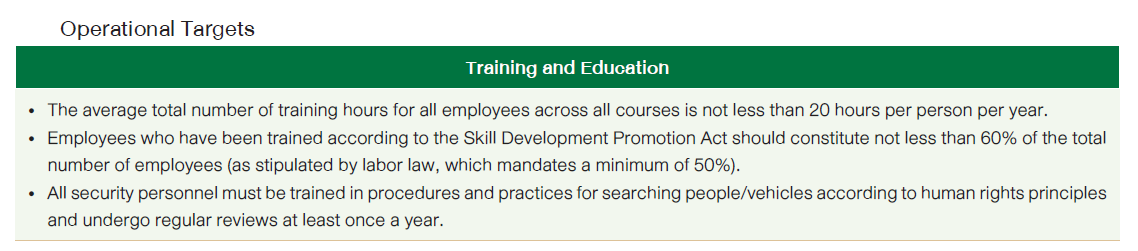
- The Company continuously focuses on developing employees’ skills and capabilities. In 2025, the total training hours amounted to 28,183 hours, with an average of 4 training days per employee and an average of 23.99 training hours per employee, which exceeded the Company’s target of at least 20 hours.
- Employee satisfaction assessment regarding the Company's training programs reached 90% in 2024, highlighting the effectiveness of these initiatives.
- In 2025, 50% of employees completed training in accordance with the standard of the Promotion of Labour Skills Development Act, surpassing the Company's established target.
- Employees who have undergone training will develop better problem-solving skills, management abilities, and work behavior, leading to career growth opportunities and improved compensation, including benefits, based on the Company's criteria.
- The Company has organized a project to develop potential and advancement through training to promote and align with employees' career growth (Career Development), which is a mandatory course for various position adjustments. It is designed based on work evaluation results and fair criteria to prepare employees for higher positions and enhance job satisfaction. In 2025, the average score reached 83.70%, exceeding the target of 75%. Additionally, this led to a decrease in the employee turnover rate and voluntary resignation rate in 2025 compared to 2024, as follows :

- The Company leveraged E-Learning technology to deliver training on key technical topics, including production, maintenance, and occupational health and safety. This allowed employees the flexibility to access and review training content conveniently.
- The Company has participated in training programs on labor standards organized by government agencies and industry organizations, such as training on the prevention of child labor and forced labor, enhancing workplace safety, and labor practices in accordance with Thai labor laws. The knowledge gained from these programs has been applied to improve the Company’s labor management and supply chain practices in alignment with relevant standards.
- The Company provides training for managers and supervisors on handling cases of workplace bullying and harassment. The training covers procedures for receiving complaints, conducting fact-finding investigations, protecting complainants, and establishing preventive measures to avoid recurrence. This ensures that frontline and middle-level managers are able to respond to and resolve such incidents appropriately and fairly.